Key insight 1
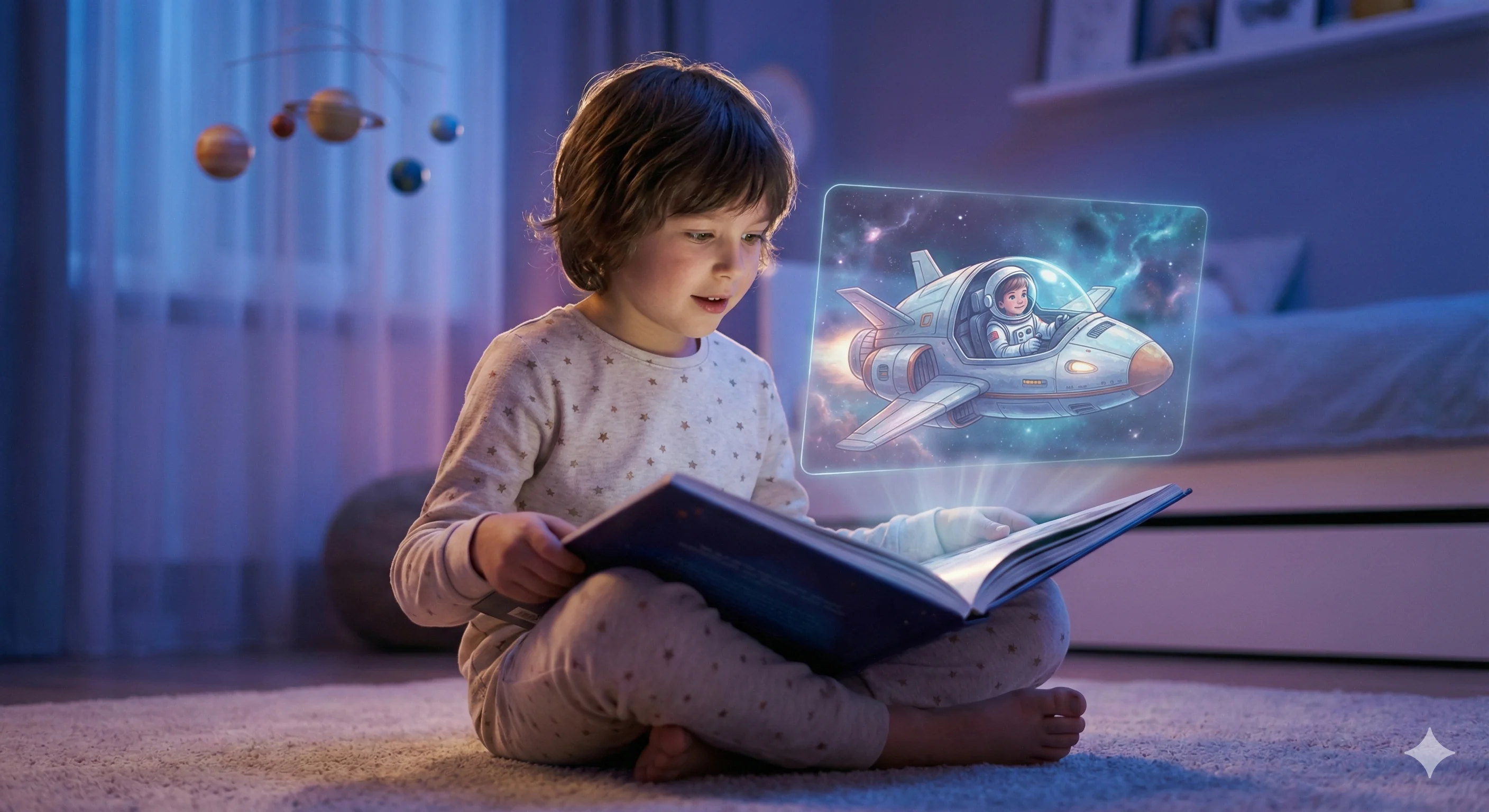
Space exploration represents one of humanity's greatest adventures, capturing children's imaginations and inspiring scientific curiosity. Research from STEM education and identity development demonstrates that personalized books featuring space adventures can serve as powerful tools for fostering scientific interest, developing STEM identities, and promoting scientific thinking. When children see themselves as astronauts, scientists, or space explorers in personalized stories, they develop stronger connections to STEM fields and more positive attitudes toward scientific learning. Scientific studies provide compelling evidence for the unique effectiveness of personalized space narratives in promoting STEM engagement.
A comprehensive study published in the Journal of Research in Science Teaching (2021) examined the impact of personalized versus generic space books on 180 children aged 5-10. The research found that children who read personalized space adventure books featuring themselves as astronauts showed a 50% increase in science interest, a 45% improvement in scientific vocabulary, and a 55% increase in STEM career interest compared to those who read generic space books. The study attributed this significant difference to what STEM education researchers call "STEM identity development" - when children see themselves successfully engaging in scientific activities in personalized stories, they develop positive STEM identities and increased confidence in their scientific abilities.
Key insight 2
The power of personalization in space books extends to scientific thinking and inquiry skills. Research from science education demonstrates that personalized narratives are more effective at promoting scientific thinking than generic information because children see themselves as active scientists making observations, asking questions, and drawing conclusions. When children read about themselves conducting experiments, making discoveries, or solving problems in space stories, scientific thinking becomes part of their identity rather than abstract concepts. Studies show that children who read personalized space books demonstrate improved scientific reasoning, better hypothesis formation, and increased curiosity about scientific phenomena.
One of the most significant benefits of personalized space books lies in their ability to make abstract scientific concepts concrete and accessible. Research from science education demonstrates that children often struggle to understand abstract concepts like gravity, planetary motion, or the scale of the universe. Personalized stories can make these concepts tangible by showing the child character experiencing them directly - feeling weightlessness, observing planetary orbits, or comparing sizes. A study from MIT (2020) found that children who read personalized space books with concrete scientific experiences showed better understanding of scientific concepts and increased motivation to learn more about space science.
Key insight 3
Personalized space books also address the critical need for diverse representation in STEM fields. Research from STEM education demonstrates that many children, particularly girls and children from underrepresented groups, don't see themselves as potential scientists or astronauts, limiting their STEM engagement. Personalized stories allow all children to imagine themselves as space explorers, breaking down barriers to STEM participation. Studies show that children who read personalized space books featuring themselves demonstrate increased STEM confidence and stronger interest in pursuing STEM subjects, regardless of gender or background.
The timing of space education proves crucial for maximum effectiveness. Research indicates that optimal impact occurs when children are exposed to space concepts during early childhood, when scientific curiosity and identity formation are developing. Personalized stories provide age-appropriate space education that matches children's developmental level, making complex scientific concepts accessible and engaging. Studies show that children who engage with personalized space books during early childhood demonstrate stronger scientific interest and more positive STEM attitudes throughout their development.
Key insight 4
Personalized space books also serve as powerful tools for developing spatial reasoning and mathematical thinking. Research from cognitive development demonstrates that understanding space concepts requires sophisticated spatial reasoning, scale understanding, and mathematical thinking. Personalized stories engage these cognitive processes more deeply because children actively imagine themselves in space environments, manipulating objects, and understanding relationships. A study from the University of Chicago (2021) found that children who read personalized space books demonstrated improved spatial reasoning, better understanding of scale and proportion, and increased mathematical problem-solving skills.
Furthermore, personalized space books create opportunities for family scientific engagement. Research shows that when parents read personalized space books with their children, it creates natural opportunities for discussing scientific concepts, exploring space together, and engaging in scientific activities as a family. These shared experiences strengthen family bonds while supporting children's scientific development. Studies indicate that families who engage with personalized space books together show increased family scientific conversations and stronger intergenerational scientific interest.
Key insight 5
The research evidence strongly supports the use of personalized space adventure books for STEM development. These books combine STEM education research, identity development theory, and cognitive development principles to create comprehensive tools for scientific engagement. When thoughtfully designed with accurate scientific content and personalized elements, space books become powerful vehicles for fostering curiosity, developing STEM identities, and promoting scientific thinking. For families seeking meaningful ways to support their children's scientific interests while promoting STEM engagement, personalized space adventure books represent a research-backed approach that transforms space fascination into scientific learning.